MUGGILL

One name. Nine generations. Three hundred sixteen years.
Groningen · The Atlantic · Indiana · The present

Explore a family history from Groningen to the Potomac.

De provincie Groningen · The Dutch shore of the story
Generatie I · The First Name in the Register

Pieter Geerds Mug

b. 1710, the Groningen coast - death unrecorded
Een dag in het leven - a day in the life
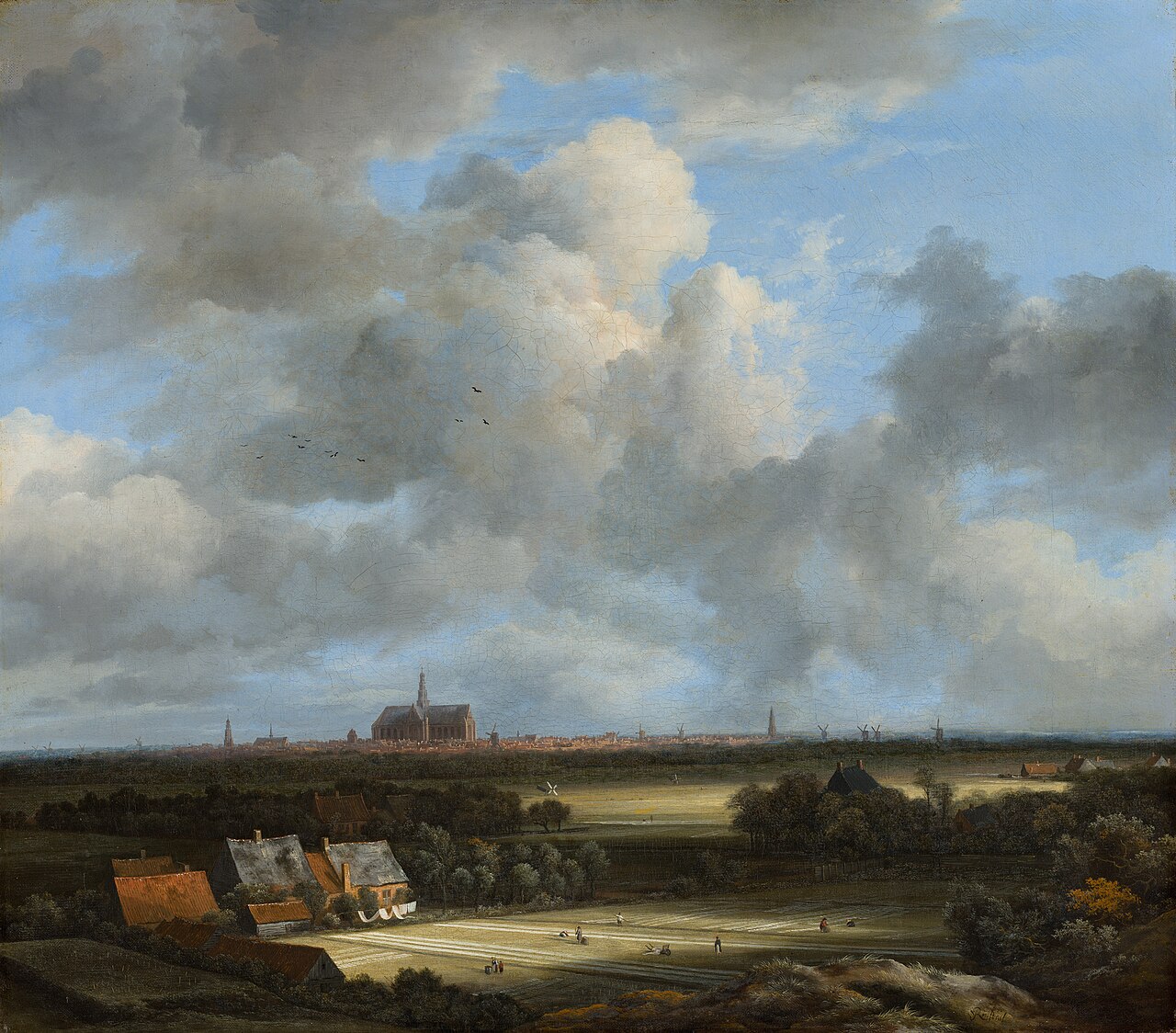
Jacob van Ruisdael's View of Haarlem: an immense cloud-filled sky over flat Dutch farmland, a distant church on the horizon.
Improvisation on the Arp Schnitger organ of 1687
The organ builder whose instruments still stand in Groningen's churches. Enno Gröhn, Steinkirchen · CC BY-SA
5:56
Jacob van Ruisdael, View of Haarlem with Bleaching Grounds, c. 1670-75, oil on canvas, Mauritshuis. Painted in Holland a generation before Pieter's birth; the sky-heavy flatness is the same country his Groningen was. Public domain, via Wikimedia Commons.

A day in the spring of 1744

Before light

Pieter wakes before sunrise on the Groningen clay. He is thirty-four. He will marry Trinje in Kloosterburen in June. Their son is already born. The Hogeland is called the "high land" because people raised it above the sea.

Morning · the dike

The village repairs the dikes each year. In Christmas week of 1717, a storm flooded the coast. Pieter was seven. More than two thousand people died in Groningen. His generation treats dike repair as necessary work.

Midday · names

The parish record calls him Pieter Geerds. The name means Pieter, son of Geert. The second name Mug later becomes the family surname. No record explains its origin. The Dutch word mug means mosquito, but this connection is not proven.

Evening

The family eats buttermilk and rye. Catholic families practice their faith quietly. A Catholic church opened at Den Hoorn in 1733. Pieter's grandchildren will join this parish. The household uses little candle wax because wax is expensive.

Historical reconstruction
Records confirm Pieter's birth year, marriage, and son. Historical sources provide the other details about the Hogeland during his life.
Generatie II · The Hidden-Church Years

Geert Josephus Pieters Mug

b. 13 March 1744, Den Hoorn - d. before 4 July 1822, Kloosterburen
Een dag in het leven - a day in the life

A Sunday in the autumn of 1788

Before the bell

Geert was born in 1744. A Catholic church opened at Den Hoorn eleven years earlier. It was the first local Catholic church since the Reformation. His grandparents heard Mass in barns. Geert can worship in a church building.

Morning · the walk

The road runs between Kloosterburen and Den Hoorn. Maria walks beside Geert. She came from Meppen in the Münsterland. Many German Catholics traveled west each year for paid farm and peat work. Maria stayed and married Geert.

Midday · the middle name

Geert has the middle name Josephus. This was unusual for a rural man in this period. The Latin name shows the family's Catholic identity in the parish record.

Evening

Geert and Maria will have seven children. Their son Jan is born in 1781. In that year, Theodorus Beckeringh publishes his map of Groningen. No known record places Geert outside the province.

Historical reconstruction
Records confirm Geert's dates, marriage, and parish. Historical sources provide the details about Den Hoorn and Westphalian workers.
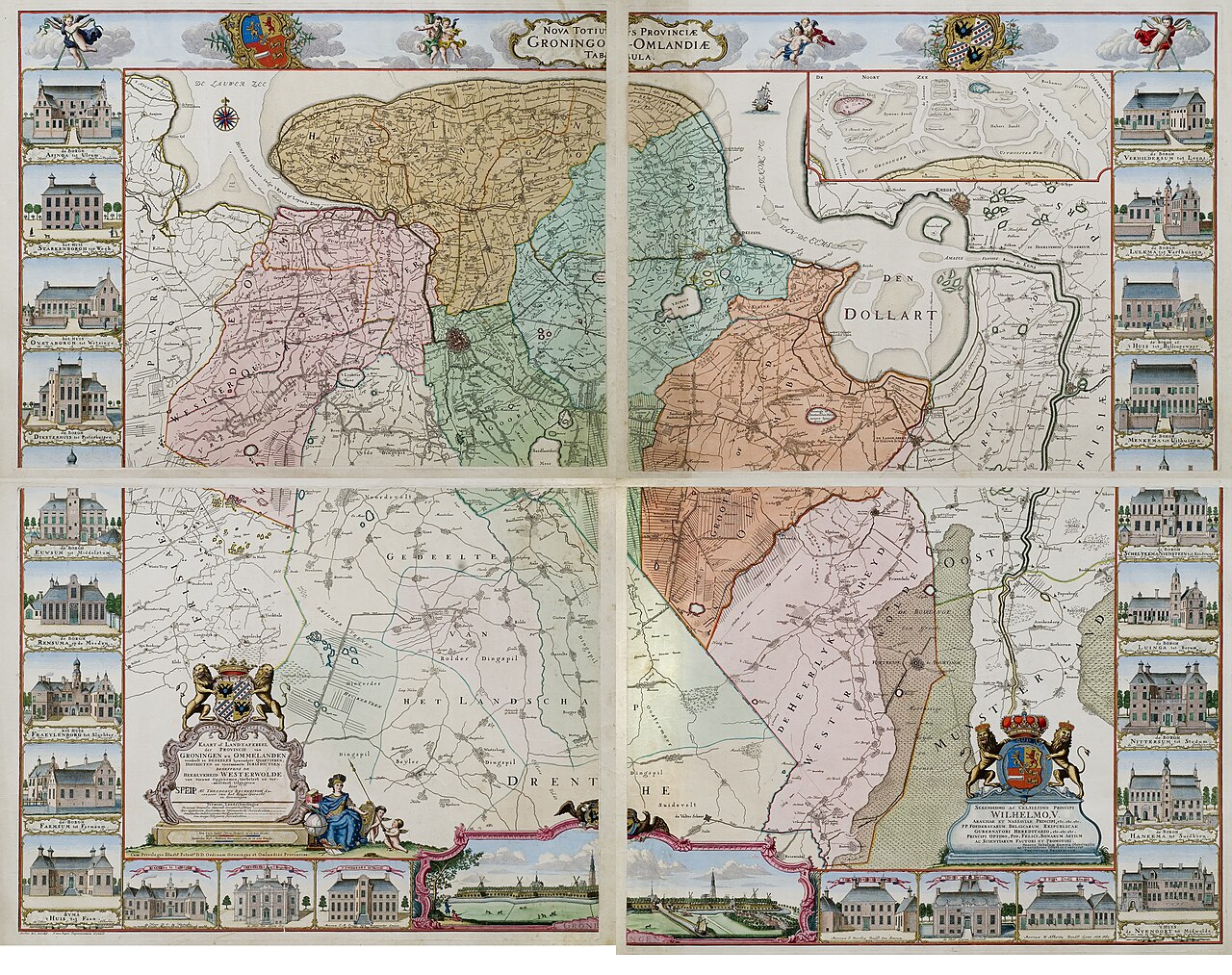
Theodorus Beckeringh's 1781 hand-colored map of Groningen province, bordered with engraved vignettes of manor houses.
Toccata in the baroque style · Arp Schnitger organ, St. Jacobi
Improvised on a 1693 Schnitger instrument, the sound-world of Geert's century. Enno Gröhn · Wikimedia Commons
4:35
Theodorus Beckeringh, Kaart of landtafereel der provincie van Groningen en Ommelanden, engraved 1781 - the year Geert's son Jan was born. Wehe-den Hoorn and Kloosterburen sit near its northwestern edge. This was the entire world of his seventy-eight years. Public domain, via Wikimedia Commons. View full artwork →
Generatie III · The Tailor

Jan Geerts Mug

b. 16 April 1781, Den Hoorn - d. 1 August 1832, Kloosterburen
Een dag in het leven - a day in the life
“No longer just Jan, son of Geert: Mug, set down in the register at the mairie - a fixed, legal thing.”
The surname decree reaches Kloosterburen · 1811
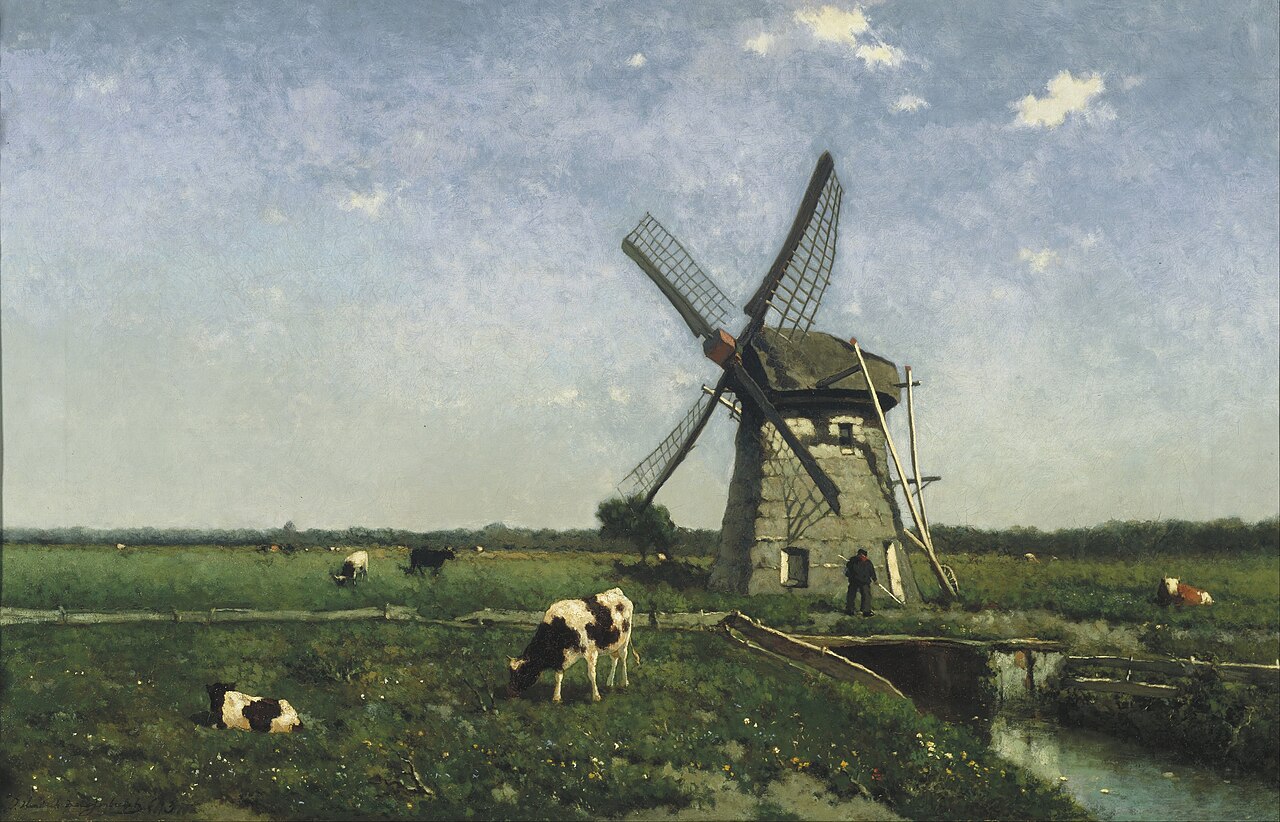
Oil painting of a Dutch polder: a stone windmill beside a ditch, grazing cattle, and a towering summer sky. Johan Hendrik Weissenbruch, 1873.
Salve Regina · plainchant, 11th century
Sung at vespers in every Catholic parish, including this one. Les Petits Chanteurs de Passy · CC BY-SA
3:10
Johan Hendrik Weissenbruch, Landscape with Windmill near Schiedam, 1873, oil on canvas. He painted this polder two hundred miles south of Kloosterburen and forty years after Jan died. Both places share flat land, water, and wind. Public domain, via Wikimedia Commons.

A Tuesday in the spring of 1810

Before the bell · half-past five

Jan wakes before sunrise as wind crosses the dike from the Wadden Sea. A mill, a church tower, and the sea dike rise above the flat polder. He lights the coals. Then he starts work at a bench beside the window.

Morning · the bench by the window

Jan works as a tailor. He uses wool, linen, and bombazine. He cuts the cloth with an old paper pattern. Catharina was born in nearby Eenrum. She prepares thread and cares for the children.

Midday · the enclave

Kloosterburen remains Catholic in a mostly Protestant province. Catholics worshiped in barns for about a century. Authorities permitted a church at Den Hoorn in 1733. The Mugg family later carries this faith to America.

Evening · the ledger

The family eats rye bread and buttermilk porridge. Jan records his work and payments in a ledger. In 1811, Dutch law requires fixed surnames. The family now uses Mug as its legal surname.

Historical reconstruction
Records confirm Jan's dates, family, and work as a tailor. Historical sources provide the other details about Kloosterburen.

Draden · Related history

Open a source for more context

The Catholic island

Kloosterburen grew around a 12th-century abbey. The village stayed Catholic while public Catholic worship was illegal in Groningen. A local church opened in 1733.

Wikipedia · Kloosterburen →

A mosquito over the polder

Mug is the Dutch word for mosquito, an old word at home in a landscape of ditches and standing water. When Napoleon's 1811 decree forced every Dutch family to register a fixed surname, names like this were set down in ink for good.

Wiktionary · mug →

The summer of 1832

Jan died on 1 August 1832. Cholera had recently reached the Netherlands. A severe fever epidemic struck Groningen six years earlier. Jan's cause of death is unknown.

Wikipedia · the cholera pandemic →

The tailor's trade, c. 1800

Village tailors cut christening gowns, wedding suits, and funeral cloth for the same families across whole lifetimes. It was skilled, indoor, respectable work in a province where most men bent their backs to clay.

Wikipedia · tailoring →

When the state began keeping names

In 1811 the Netherlands introduced civil registers of births, marriages, and deaths. The new system turned names, parents, occupations, and addresses into the paper trail that makes Jan's generation traceable.

Nationaal Archief · civil registration →

From parish book to family tree

Dutch genealogy crosses a documentary seam at 1811: church baptism, marriage, and burial books before it; civil certificates and population registers after it. Jan's life sits directly across that divide.

Nationaal Archief · church books before 1811 →
Interlude · The Crossing · c. 1850s
MUG MUGG

Jan the tailor died in 1832. His son was five. The son left Kloosterburen as Jan Mug. Indiana records later name him John Mugg. The surname gained a second G during this migration.

The potato blight of 1845-47 caused hunger in the Dutch countryside. Dutch emigration reached a new high in 1847. Catholic and landless families from Groningen joined this movement. Some communities formed again in America.

No document explains the second G. A clerk could have changed the spelling. A passenger list could also contain the change. John could have chosen it himself. The ship and year remain unknown.

The record resumes in Tippecanoe County, Indiana.
America · The Wabash Valley
Generation IV · The Emigrant

John Mugg

b. 23 August 1826, Kloosterburen - d. 23 December 1879, Tippecanoe County, Indiana
Een dag in het leven - a day in the life
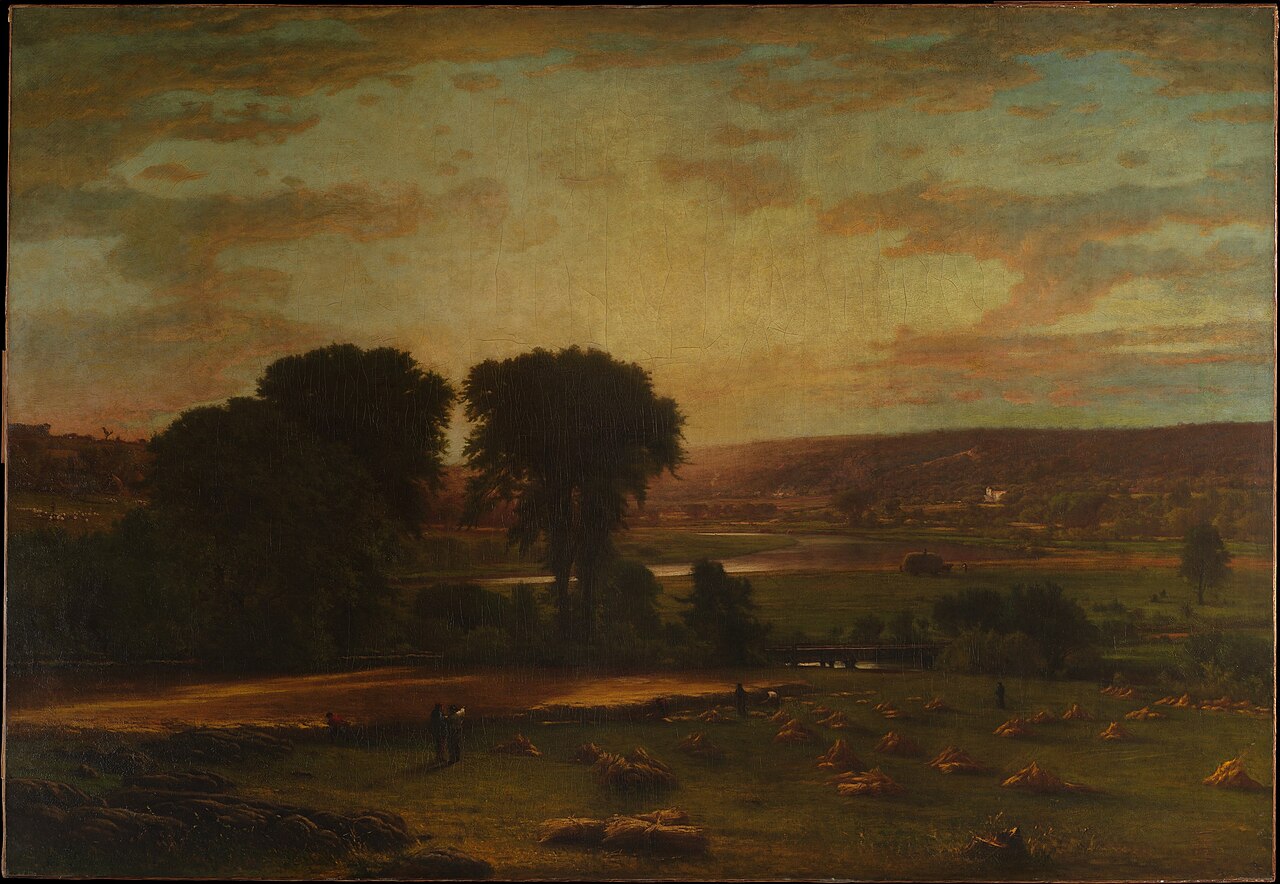
George Inness, Peace and Plenty: an American harvest valley at golden evening, wheat sheaves in the field, a river beyond.
Grosser Gott, wir loben dich · the German Te Deum
The hymn of German-speaking Catholic parishes like St. Boniface. Nebe-Quartett, 78 rpm, c. 1912 · Internet Archive
 
George Inness, Peace and Plenty, 1865, oil on canvas, The Metropolitan Museum of Art. Painted the year St. Boniface church went up in Lafayette: the American harvest-country John Mugg traded the polder for. Public domain, via Wikimedia Commons.

A harvest day, October 1866

First light

John notices that the land in the Wabash Valley rises and falls. The land around Kloosterburen was flat. Indiana has no sea dike. Both places have clay soil and demanding farm work.

Morning · the field

Corn stands in rows. A threshing crew processed the wheat in August. Anna works beside John. She was also born in the Netherlands. Their five-year-old son Christian carries water.

Midday · the German church

The family travels to St. Boniface in Lafayette on Sunday. German-speaking Catholics founded the parish in 1853. They built its brick church in 1865. John now worships in German, his third language.

Evening

No known letter from John to the Netherlands survives. His parents are dead. His son knows Kloosterburen only by name. John dies on 23 December 1879. He is buried at St. Boniface, where two Mugg generations share a family plot.

Historical reconstruction
Records confirm John's dates, marriage, and burial. Historical sources provide the details about St. Boniface and Midwest farming.
Generation V · The Farmer

Christian Mugg

b. 29 April 1861, Tippecanoe County - d. 19 April 1923, buried St. Boniface, Lafayette
Een dag in het leven - a day in the life

Threshing day, July 1898

Half-past four

The threshing machine arrives today, so work starts before sunrise. Christian is the first American-born Mugg. His father was Dutch, but Christian knows only Indiana. The steam engine arrives with a crew of neighbors.

Morning · the ring

Wabash Township farmers share one threshing machine. Each family supplies labor when the machine reaches another farm. Christian pitches bundles with his neighbors. Catherine prepares food for about twenty people.

Midday · the table

The meal includes fried chicken, potatoes, pies, and coffee. Seven-year-old Harry carries water to the crew. Purdue University grows across the river. Harry will graduate there in 1914 as the first Mugg with a degree.

Evening

The engine moves to the next farm at dusk. Christian farms for about two more decades. He dies ten days before his sixty-second birthday. He is buried at St. Boniface, like his father.

Historical reconstruction
Records confirm Christian's dates and marriage. Historical sources provide the details about shared threshing work in the Midwest.
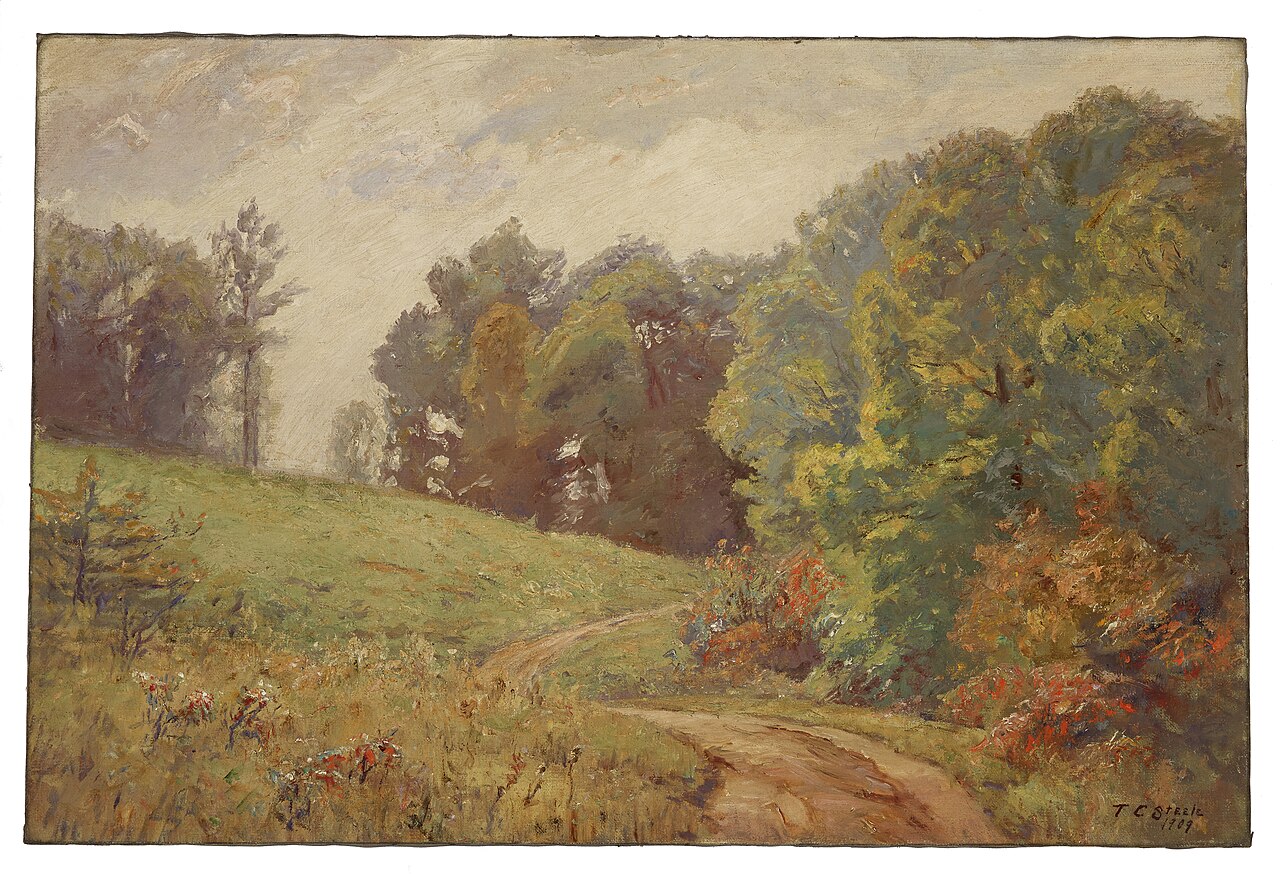
T.C. Steele, Indiana Landscape: a dirt road curving into autumn trees under a pale Indiana sky.
Soldier's Joy / Turkey in the Straw · fiddle medley
The barn-dance repertoire of the rural Midwest. Don Richardson, 78 rpm, 1916 · Internet Archive
 
Theodore Clement Steele, Indiana Landscape, oil on canvas, Indianapolis Museum of Art. Steele painted Indiana's roads and woodlots while Christian farmed them, one county over. Public domain, via Wikimedia Commons. View full artwork →
Generation VI · A Life Cut Short

Harry Christian Mugg

b. 7 February 1891, Indiana - d. 3 February 1920, Akron, Ohio
Een dag in het leven - a day in the life
“Six feet two in his ‘holeproofs’ - ‘Heavy’ to the class, ‘Hank’ to his friends.”
The Purdue Debris yearbook · 1914
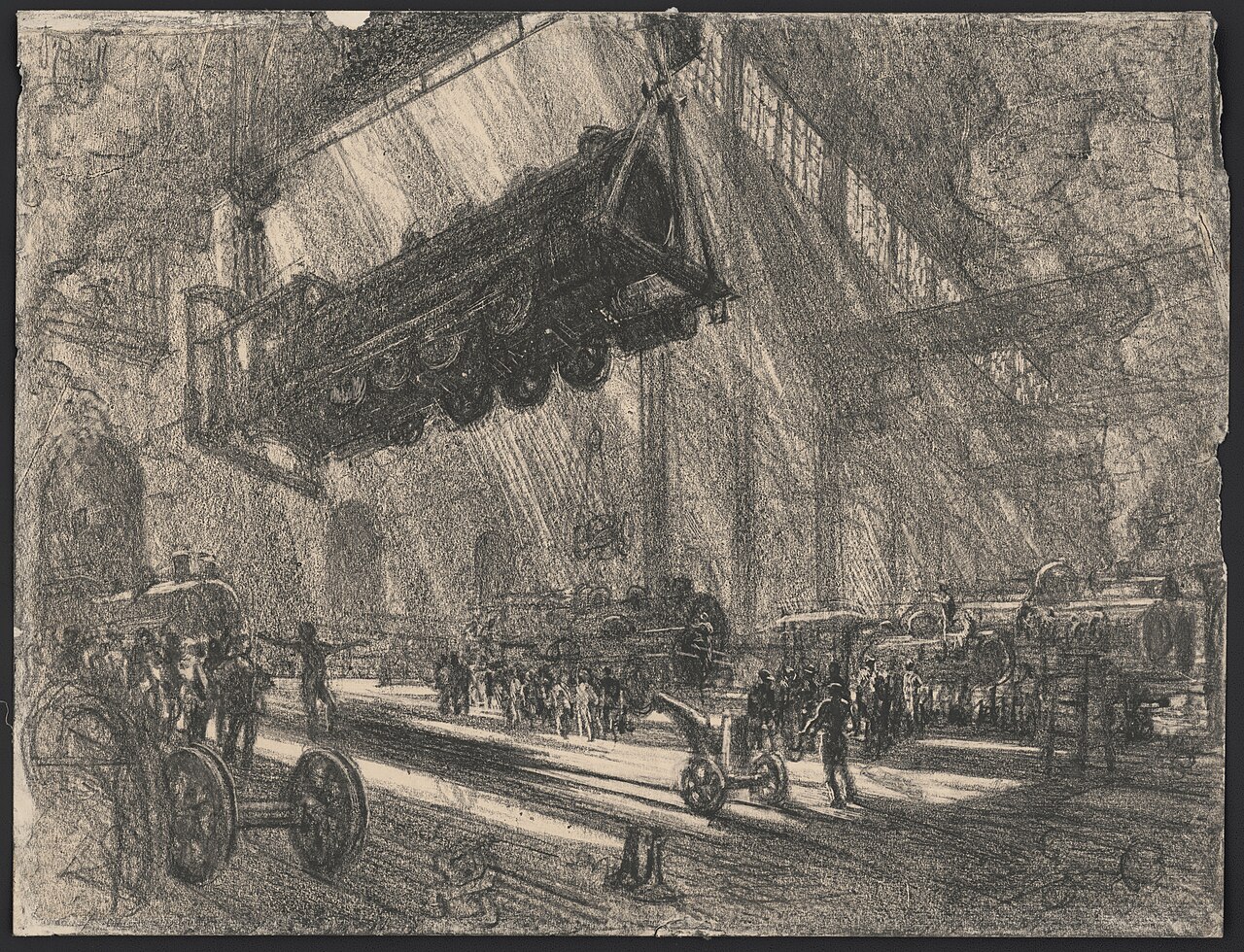
Joseph Pennell lithograph: a locomotive hoisted through the smoky air of a vast erecting shop, tiny workers below.
Till We Meet Again · Campbell & Burr, 1918
The parting song on every parlor phonograph in Harry's last years. OKeh 78 rpm · Internet Archive
3:26
Joseph Pennell, The Flying Locomotive, lithograph, 1917, from Pictures of War Work in America, Library of Congress. The machine-age industrial America that pulled a farmer's son to Akron. Public domain, via Wikimedia Commons.

A shift day, January 1920

Six o'clock

Akron is the fastest-growing American city in 1920. Coal smoke and rubber fumes cover the valley. Harry graduated from Purdue with a Bachelor of Science in 1914. Akron's population grew from 69,000 to 208,000 in ten years.

Morning · the works

Purdue's Debris yearbook describes Harry as six feet two inches tall. Classmates call him "Heavy," and friends call him "Hank." He joins the Newman Club and Canoe Club. His science degree could support laboratory work, but his job is not recorded.

Evening · the letter

Harry lives near the factories. Morna and their four-year-old son Michael remain in Indiana. Harry married Morna Byrne in Chicago four months after graduation. Work now separates the family. No known letter from this period survives.

Four days short

Harry dies on 3 February 1920, four days before his twenty-ninth birthday. The available record does not give a cause. Influenza returns to the industrial Midwest that winter. The site does not claim that influenza caused his death. Morna becomes a widow at twenty-seven.

Historical reconstruction
Records confirm Harry's dates and his 1914 Purdue yearbook entry. Historical sources provide the details about Akron's rubber industry. His cause of death remains unknown.

Related history

Open a source for more context
Interlude · The Second Change · c. 1915
MUGG MUGGILL

Harry graduated and married in 1914 as a Mugg. The Purdue yearbook records him as MUGG, HENRY CHRISTIAN. His son was born in June 1915. The family tree records the son as Michael Byrne Muggill. Harry and his father continued to use Mugg.

No available document explains the change. A clerk could have changed the spelling. Morna could have selected the name. Michael could also have selected it later. These are hypotheses, not facts.

Every living Muggill descends from this change. The original 1915 birth record could provide an answer. Finding that record is the highest-priority research task.

One family, one bearer of the new name. The line continues through him.
Generation VII · The First Muggill

Michael Byrne Muggill

b. 12 June 1915, West Lafayette - d. 17 February 1993, Orange, California
Een dag in het leven - a day in the life
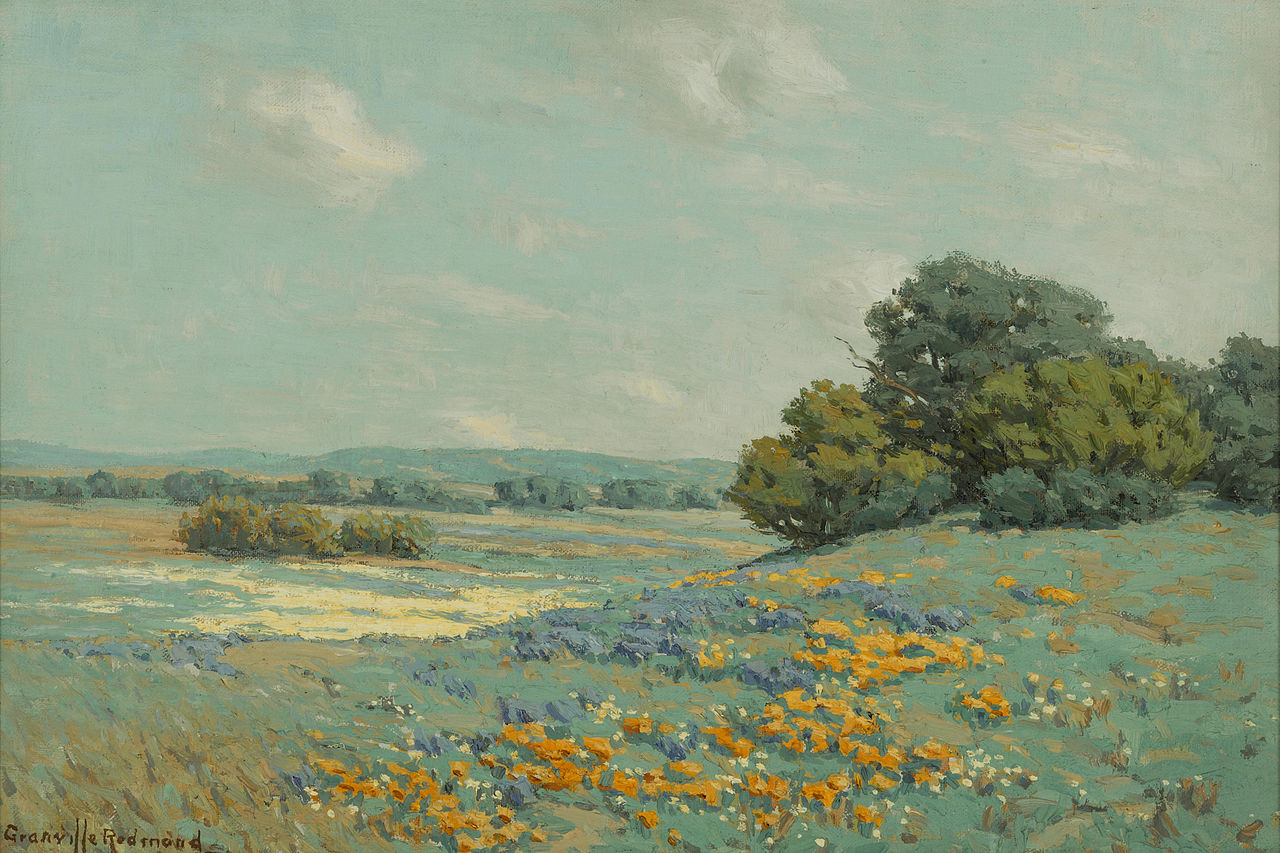
Granville Redmond, California poppy field: orange poppies and blue lupine scattered across a soft green coastal plain.
California, Here I Come · Cliff Edwards, 1924
The anthem of the westward move, cut when Michael was a boy. Perfect Records 78 rpm · Internet Archive
2:54
Granville Redmond, California Poppy Field, oil on canvas. Redmond, a deaf painter and friend of Chaplin, painted the coastal California that the Muggills reached two generations after leaving the polder. Public domain, via Wikimedia Commons.

A Saturday in March, 1963

Morning · the coast

Michael is forty-seven. His father died when Michael was four. He grew up during the Depression and married in Chicago in 1938. His son was born in 1941. The family later joined the postwar migration to California.

Midday · the paper

The Santa Barbara News-Press publishes a short item about his son. The family keeps the clipping, and it remains a source in the tree. Michael Nash is twenty-one. The name Muggill now appears in a California newspaper.

Afternoon

Southern California changes quickly in 1963. Subdivisions replace orange groves, and aerospace work supports new communities. The climate and landscape differ from Indiana and Groningen. The rare surname now identifies this family more than any place.

Evening

Michael lives for three more decades. He dies in Orange County in 1993. He knew relatives who used the name Mugg. He also carried the new name to the Pacific coast.

Historical reconstruction
Records confirm Michael's dates and the 1963 newspaper citation. Historical sources provide the details about postwar California. The site does not add unverified work or household details.
Generation VIII · Living

Michael Nash Muggill

b. 1941, Chicago
De wereld waarin hij aankwam - the world he arrived in
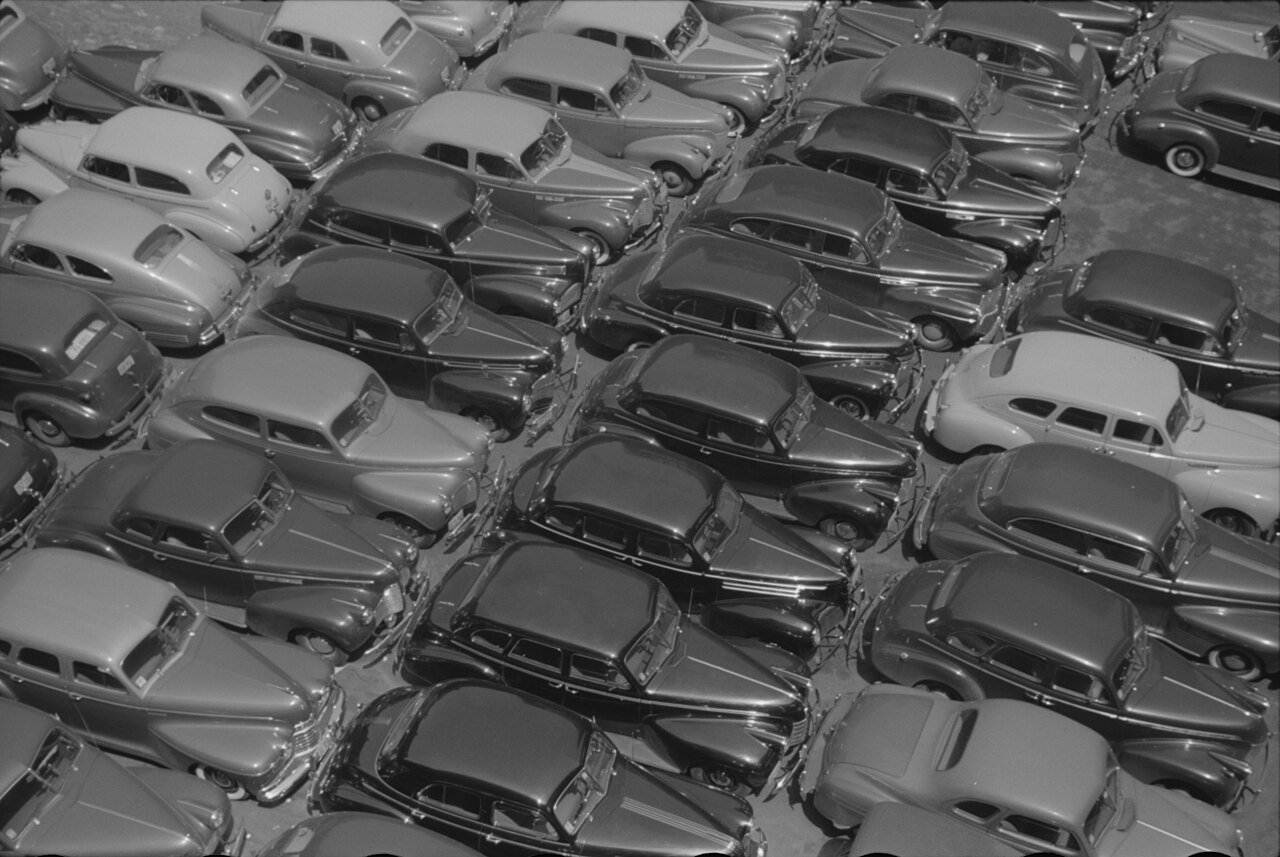
John Vachon photograph, July 1941: rows of parked automobiles filling a Chicago lot, gleaming under summer light.
Working Man Blues · King Oliver's Creole Jazz Band
Recorded in Chicago, 1923 - the city's sound, pressed in shellac. OKeh 78 rpm · Internet Archive
 
John Vachon, Parking lot, Chicago, Illinois, July 1941, Farm Security Administration. Photographed months before Michael Nash was born into this exact city. Public domain (U.S. government), via Wikimedia Commons.

Chicago, the winter of 1941

A note on this chapter

Michael Nash Muggill is living. This site protects his private information. The chapter describes the public history of the period when he was born.

The city

Chicago has about three and a half million residents in late 1941. Railroads and factories drive the city's economy. Ellen Nash Muggill gives birth in her home city. She and Michael Byrne married there three years earlier.

The season

Michael was born near the time of the Pearl Harbor attack. The attack brought the United States into the Second World War.

The line

Public records provide only a few later events. The family moved to California during his youth. Michael married in Arlington, Virginia, in 1995. His son Patrick was born in Bethesda in 1996. The site does not publish other personal details.

Historical reconstruction
This chapter describes a historical period instead of a personal day. It uses only facts that appear in public records.
Generation IX · The Present Bearer

Patrick Michael Muggill

b. 1996, Bethesda, Maryland
Een dag in het leven - a day in the life, 2026

A Thursday in 2026

Morning · the river

Patrick lives in Arlington, Virginia, across the Potomac from Washington. His parents married nearby. Seven generations separate him from Jan, the tailor in Kloosterburen. Patrick works remotely with a computer and a network connection.

Daytime · the machines

Patrick works at Cisco as an enterprise architect. He maps networks, data, and connected systems. The work has a link to earlier records. Beckeringh mapped Groningen, and parish clerks mapped the family through written records.

Evening · the file

Patrick graduated from the University of Virginia. He studies a GEDCOM file with 114 people. This file supplies the family data for the site. His personal site, patrick.md, contains short notes about his current work and ideas.

The name

Patrick is the ninth generation in this direct line. He maintains the research and this site. Future family members can use both.

Historical reconstruction
Patrick reviewed this chapter. His public profiles and personal records provide the facts. The description of his daily routine remains a reconstruction.
The Rosslyn skyline of Arlington, Virginia seen from Georgetown across the Potomac River.
Touching Moments Two - Higher · Kevin MacLeod
Music of the present generation, freely licensed like everything on this page. CC BY 3.0
2:54
Rosslyn, Arlington, Virginia, from across the Potomac. Photo by NCinDC, CC BY 2.0, via Wikimedia Commons. View full artwork →

The Research Desk

Three research questions are open. Each item lists the available evidence, missing records, and next action.

Priority 1

Why did Mugg become Muggill?

Harry graduated and married as Mugg in 1914. His son appears as Michael Byrne Muggill in 1915. No available document explains the added syllable.

Available evidence
The 1914 Purdue yearbook, Harry and Morna's marriage record, later records using Muggill, and the surrounding family chronology.
Missing evidence
The original June 1915 West Lafayette birth record, including every handwritten and amended field.
Current hypotheses
A clerk's spelling, Morna Byrne's choice, or Michael's later choice are plausible. None is proven.
Next action
Request the original record image from the Indiana Department of Health or Tippecanoe County and compare the earliest dated uses of Muggill.
Migration question

Which ship carried John Mug?

John left Kloosterburen as a Mug and appears in Indiana as John Mugg. The ship, arrival port, and exact year have not been identified.

Missing evidence
A passenger list, emigration register, naturalization file, or earliest US record that bridges the Netherlands and Indiana.
Next action
Search Dutch emigration records and US passenger indexes across the likely 1847-1860 window using both Mug and Mugg.
Origin question

Who came before Pieter?

Pieter Geerds Mug is the earliest bearer currently connected to the direct line. His death record and the generation before him remain unresolved.

Missing evidence
Earlier Den Hoorn or Kloosterburen parish entries, tax lists, household registers, and a death or burial record for Pieter.
Next action
Work backward through Catholic parish material and regional archives, keeping patronymics separate from fixed surnames.

De reis · The Journey

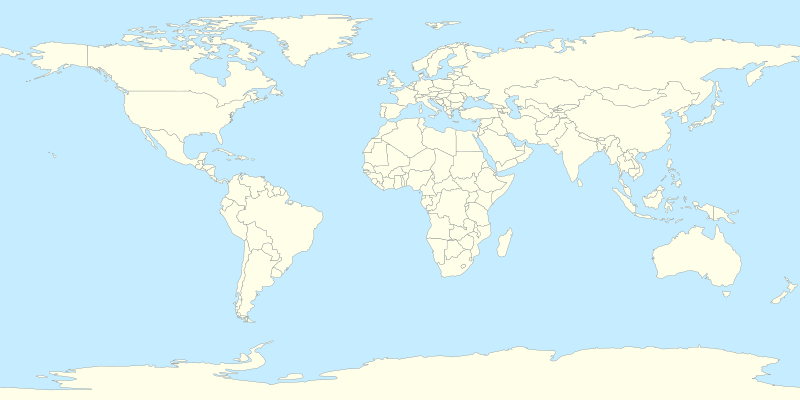
Nine generations cover about 9,000 miles. Select each route step, or select Play.

Use to move between chapters. Use to move through the route.
Base map: World location map by STyx et al., CC BY-SA, via Wikimedia Commons; route and tint added.

De stamboom · The Tree

The family record contains 114 people. It includes the Mug line and connected families. Select a name to view that person. The site shows only names for living people.

The family GEDCOM file supplies this data. The site does not show dates or places for living people.
Report an error or add a source at the Research Desk.

Source Register

The site separates verified facts from historical reconstruction. These entries list the source groups for each direct-line chapter. Exact references will be added after review of the private Ancestry citations.

G1

Pieter Geerds Mug

Groningen Catholic church records and the family GEDCOM. Earliest bearer currently connected to the direct line.

G2

Geert Josephus Pieters Mug

Den Hoorn and Kloosterburen church and civil records, cited through the family tree.

G3

Jan Geerts Mug

Dutch civil registration, church records, marriage entry, occupation, and death details.

G4

John Mugg

US census and Indiana records, plus St. Boniface burial material. The emigration record remains missing.

G5

Christian Mugg

Indiana marriage and burial records and St. Boniface family-plot evidence.

G6

Harry Christian Mugg

Illinois marriage record, Ohio death record, and the 1914 Purdue Debris yearbook.

G7

Michael Byrne Muggill

Illinois marriage records, California death index, and a Santa Barbara News-Press family citation. The original 1915 birth record is not yet held.

G8

Michael Nash Muggill

This entry uses public records only. The site does not show private details because this person is living.

G9

Patrick Michael Muggill

The bearer, his own records, and the public profiles he approved for this project.

Bronnen · Sources & credits

The Muggill family GEDCOM file supplies the family data. Its citations include Dutch, church, census, vital, and newspaper records. Each chapter links to its historical context sources.

The site hosts public-domain and Creative Commons art and recordings. See the full attribution list for creators, licenses, and source institutions.

Each chapter labels its historical reconstruction. The verified record panel lists documented facts. The reconstructed day is not a historical record.